
Raja Jon Vurputoor Chari, 43, a graduate of the US Air Force Academy, MIT and US Naval Test Pilot School, is the only Indian-American in the list.

China's first lunar rover on Saturday successfully landed on the moon, making the communist giant one of three world powers to make a "soft landing" as part of an ambitious programme that aims to put a Chinese astronaut on the moon.

The Announcement of Opportunity (AO) is for space experiments by institutions in the country, and the last date for receiving the proposals is May 19, 2017, the Bengaluru-headquartered ISRO said.

China's first moon rover is back to work after a "nap" and has succeeded in sending back the first images of the national flags on itself and the lander, space authorities said on Sunday.
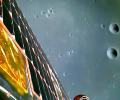
Taking to X (formerly Twitter), ISRO said, "Chandrayaan-3 Mission. Chandrayaan-3 Rover to MOX, ISTRAC, Moon walk begins!"

Its duties include experiments to further understand the lunar surface.

Indian Space Research Organisation's plan to soft land Chandrayaan-2's Vikram module on the Lunar surface did not go as per script in the early hours of Saturday, with the lander losing communication with ground stations during its final descent.

ISRO on Monday said the Vikram lander successfully underwent a hop test when it made the soft-landing again on the lunar surface.

Luna-25 may land on the lunar surface earlier than Chandrayaan-3.

During the day-long debate, the lines between science and religion often got blurred with many invoking religious texts and the contribution of 'rishi munis' to highlight India's tryst with the extra-terrestrial world.
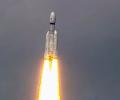
The Chandrayaan-3 mission that aims for a soft landing on the moon's surface, paving the way for future interplanetary missions, carries six payloads that would help ISRO understand the lunar soil and also get the blue planet's photographs from the lunar orbit.

'The ISRO has done enough simulations and also redundancies have been built in so that chances of such failure are remote. Still, we have to keep our fingers crossed'

Here is the timeline of the moon mission as undertaken by the Indian Space Research Organisation.

India will become the fourth country to master the technology of soft-landing on the lunar surface after the US, China and the erstwhile Soviet Union.

Weighing 320 tonne at lift-off, the vehicle used larger strap-on motors to achieve higher payload capability.
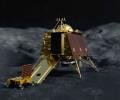
The Lander and the Rover have scientific payloads to carry out experiments on the lunar surface. The main function of the Propulsion Module (PM) was to carry the Lander Module (LM) from the launch vehicle injection till final lunar 100 km circular polar orbit and separate the LM from PM, which it did.

The tableau also showcased the participation of women scientists in various missions of the Indian Space Research Organisation (ISRO), which is now planning to carry out India's maiden human space flight next year.

Lander Module of Chandrayaan-3 spacecraft comprising the lander and rover has successfully separated from the Propulsion Module, Indian Space Research Organisation said on Thursday.

Director of Indian Space Research Organisation's Space Applications Centre based in Ahmedabad, Dr Ranganath R Navalgund said the terrain mapping camera, an Indian instrument on the lunar mission, has found "new types of rocks" and hollow tunnels.

This incredible stockpile includes nearly every photo taken my astronauts during the missions.

Chandrayaan-3 mission's rover 'Pragyan' has traversed a distance of about eight metres on the lunar surface, and its payloads have been turned on, ISRO said on Friday.
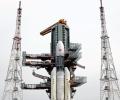
India's second mission to the moon will be launched on Monday at 2.43 pm after its initial launch on July 15 was called off owing to a "technical glitch."
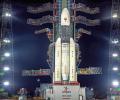
Late on Monday night, in a last-minute revision of schedule, ISRO announced that the launch of India's second lunar mission 'Chandrayaan-2' has been called off due to a technical snag.

The Chandrayaan-2 spacecraft is expected to reach the moon's orbit on August 20 and land on lunar surface on September 7.

Chandrayaan-3 mission's lander 'Vikram' chose a relatively flat region on the lunar surface to touch down, images captured by its camera showed.

Indian Space Research Organisation Chairman G Madhavan Nair met Dr Singh in Delhi on Friday afternoon and briefed him on the lunar mission launched on October 22.
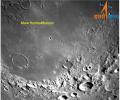
This camera that assists in locating a safe landing area -- without boulders or deep trenches -- during the descent is developed by Ahmedabad-based Space Applications Centre (SAC), a major research and development centre of ISRO.

The entire process being autonomous when the lander has to fire its engines at the right times and altitudes, use the right amount of fuel, and scan of the lunar surface for any obstacles or hills or craters before finally touching down.

Modi also asked people to take 10 pledges, including helping at least one poor family to raise its socio-economic status.

ISRO chairman S Somanath on Monday said instead of a success-based design in Chandrayaan-2, the space agency opted for a failure-based design in Chandrayaan-3, focused on what all can fail and how to protect it and ensure a successful landing.
Nervous and anxious for sure but the city-headquartered space agency is cautiously optimistic of "Vikram" module's soft-landing on the Lunar surface planned in the early hours of Saturday.

After the successful deployment of Chandrayaan-3's lander and rover on the moon, Indian Space Research Organisation (ISRO) is hoping that their mission life will not be limited to one lunar day or 14 earth days, and that they will come back to life when the sun again rises on the Moon, to carry on with the experiments and studies there.

The Vikram lander was 100 kilometers away from LRO, near Manzinus crater in the Moon's south pole region, when LRO transmitted laser pulses toward it on December 12 last year.

India on Monday successfully launched its second lunar mission Chandrayaan-2 onboard its powerful rocket GSLV-MkIII-M1 from the spaceport in Sriharikota to explore the unchartered south pole of the celestial body by landing a rover. Following the successful launch, leaders across the political spectrum congratulated the Indian Space Research Organisation for its hard work.

Here is a glimpse of the journey of India's third lunar exploration venture has taken so far.
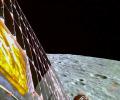
As scientists at the Indian Space Research Organisation (ISRO) gear up for the much-awaited soft landing of the Chandrayaan-3 spacecraft on the Moon's surface, the space agency may postpone the touchdown to August 27 in the event that health parameters of the lander module are found to be "abnormal", a senior official has said.
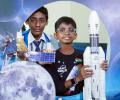
Mainstream American newspapers, many of which had been sceptical of India's space mission and sometimes even made fun of it through cartoons, noted the great Indian achievement.

Indian Space Research Organisation will announce a revised launch date later.
According to the Indian Situational Space Awareness Report for 2023, the nominal lift-off of the Launch Vehicle Mark-3, carrying the Chandrayaan-3 spacecraft, had to be delayed by four seconds based on the Collision on Launch Avoidance analysis.

The video showed the Moon in bluish green colour with many craters.
